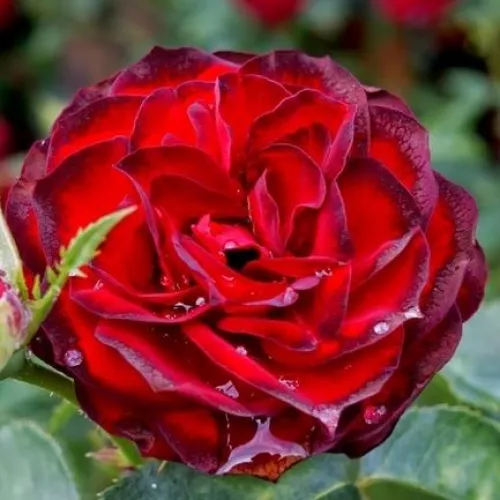
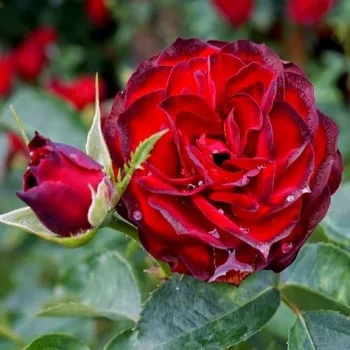
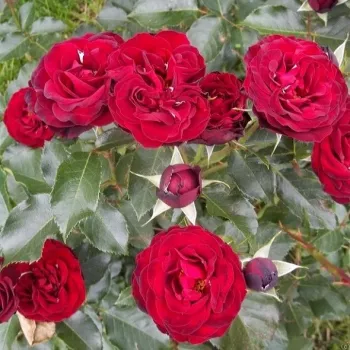
Uniform deep dark-red shade with a burgundy tone. - bedding floribunda rose - scentless rose - no noticeable fragrance
– Intense dark-red, velvety-looking blooms for impact
– Compact, bushy habit ideal for bedding schemes
– Excellent disease resistance for easy care
– Remontant flowering gives long seasonal colour
– Good heat and drought tolerance in sunny sites
– Special feature: Commemorative cultivar honouring the 1956 “pesti srácok”.
Long lifespan – Responsible plant selection
pharmaROSA® ORIGINAL 2-litre own-root potted rose
19,30 £
Unfortunately, we are currently unable to ship to the United Kingdom; we only deliver to countries within the European Union. For more information, please contact us!
5(7005)
A pesti srácok emléke – dark red bedding floribunda rose – Márk
Effortless planting meets reliable performance in this compact, dark-red floribunda that suits typical British family gardens where drainage can be challenging in heavier soils and wetter seasons. Its bushy, compact habit and uniform clusters of semi-double blooms give a tidy look from an early stage, while the remontant flowering keeps borders lively all summer with repeated flushes. The deep, slightly velvety colour holds well, resisting strong sun so the bed stays colourful rather than washed out. Bred for resistant foliage and good heat tolerance, it copes calmly with changeable UK weather and urban conditions. As an own-root rose it settles in for the long term, maturing steadily through the natural Year 1 roots, Year 2 shoots, Year 3 full display development arc into a durable, long-lived, low-intervention shrub that rewards beginners and seasoned gardeners with a consistently neat, orderly display.
Freshly opened flower of A pesti srácok emléke with deep dark-red petals.
A pesti srácok emléke showing its deep dark-red blooms in the pre-fading phase.
A pesti srácok emléke matt, középzöld lombja
Closed bud of A pesti srácok emléke, showing its deep dark-red colour.
Usage options
Target area
Reasoning
Front garden feature bed
The bushy, compact shape stays within 60–80 cm, creating a contained block of rich colour that will not overpower a small front garden. Its tidy outline needs only light pruning each spring, making it particularly practical for busy householders seeking a smart approach to the front path or drive, yet still wanting a rose that reads clearly from the pavement for beginners.
Small group planting (3–5 shrubs)
Planting in loose triangles or drifts gives a continuous sheet of dark-red flowering heads, as the remontant habit refills gaps quickly after each flush. Spacing at about 50–75 cm lets plants knit together without becoming congested, forming a low hedge-like mass that suppresses weeds and reduces the need for underplanting among beginners.
Low-maintenance family border
The cultivar’s strong disease resistance and moderate self-cleaning mean that, beyond occasional deadheading, there is little routine work. Even where weekends are the main gardening time, it maintains an acceptable look without fuss, supporting a “plant it and it works” approach that suits family gardens balancing play space with ornament for beginners.
Cottage-style mixed border
The semi-double, cupped flowers combine well with traditional perennials and grasses, while the stable dark-red colour anchors pastel companions rather than clashing with them. Because the plant stays compact and bushy, it slots easily between herbaceous clumps, adding structure without demanding intricate pruning plans, ideal for relaxed cottage compositions for beginners.
Urban and coastal gardens
Good heat and moderate drought tolerance help it cope with paved front gardens, reflected heat from walls, and breezier, more exposed sites, as long as reasonable watering is provided in dry spells. Its resilient foliage and calm response to wind suit smaller plots where shelter is limited and gardeners value dependable structural plants for beginners.
Entrances, paths and edging
The compact height and 60–85 cm spread make it ideal along paths and driveways where you want strong colour without snagging passers-by unduly, and where a neat line of shrubs defines the route. Regular flowering and clean foliage frame steps or gates with an ordered, well-tended feel that flatters even modest properties for beginners.
Long-term planting schemes
As an own-root rose it forms its permanent bush from its own wood, avoiding the unpredictability of grafted suckers and recovering well if cut back harder after harsh winters. This steady, structural reliability suits beds and borders that you prefer not to redesign frequently, giving a consistent backbone to the garden picture for beginners.
Heavier or challenging soils in small gardens
Once established, the compact structure and tolerant root system handle typical British conditions where rain and wind test lighter cultivars, especially if planted into improved soil or low raised beds to ease drainage in heavier ground. This makes it a sensible choice for those wanting colour without elaborate soil engineering for beginners.
Styling ideas
Classic frontage – Line a small front bed with a short row of these roses under a bay or clipped box, using their compact, bushy habit to echo the formality of traditional British front gardens – ideal for homeowners wanting instant smartness.
Cottage drift – Plant loose groups among catmint, hardy geraniums and foxgloves, letting the dark-red clusters punctuate softer blues and pinks while the remontant flowering keeps colour going between perennial waves – suited to romantic cottage-garden enthusiasts.
Textured contrast – Combine with Euonymus fortunei ‘Minimus’ and feather reed grass for a low, textural tapestry where the velvety red blooms rise above neat evergreens and upright grasses – perfect for design-conscious urban gardeners.
Family-friendly border – Use a ribbon of these roses at the front of a mixed border, where their disease resistance and moderate self-cleaning keep the edge looking presentable even when gardening time is limited – good for busy family households.
Container accent – Grow one plant in a 40–50 litre pot by a doorway or patio, pairing it with trailing thyme or small euonymus so the compact, repeating flower clusters provide colour without needing complex pruning – ideal for balcony and small-yard gardeners.
Technical cultivar profile
Parameter
Data
Name and registration
Commercially offered as A pesti srácok emléke, a bedding floribunda shrub rose from the Bedding rose collection; premium gold quality rating and verified cultivar authenticity for garden use.
Origin and breeding
Bred by Márk Gergely in Hungary around 2000 from ‘II. Rákóczi Ferenc emléke’ × ‘Ama’, introduced to the market in 2006 by PharmaRosa® Ltd. as an ornamental bedding floribunda.
Growth and structural characteristics
Bushy, compact shrub reaching about 60–80 cm high and 60–85 cm wide, with moderately dense, mid-green matt foliage and moderate prickliness, forming a tidy, rounded outline in beds and borders.
Flower morphology
Semi-double, cupped flowers with roughly 13–25 petals, medium-sized clusters on floribunda-style trusses; remontant habit with a notably abundant second flush, providing repeated seasonal flowering.
Colour data and phenology
Uniform intense dark-red blooms with a slightly velvety effect; RHS 187A outer and 187B inner, colour holding well with only slight lightening in strong sun, maintaining a rich tone through the flowering period.
Fragrance and aroma
No noticeable fragrance; selected primarily for visual impact, bedding performance and health rather than scent, making it suitable where colour and structure are the main design priorities.
Hip characteristics
Produces moderate quantities of spherical red hips, approximately 10–14 mm in diameter, which can add discreet autumn interest if spent blooms are not all removed during the season.
Resistance and winter hardiness
Foliage rated resistant to powdery mildew, black spot and rust; tolerates heat and moderate drought, hardy to around −21 to −18 °C (RHS H7, USDA 6b, Swedish Zone 3) in typical garden conditions.
Horticultural recommendations
Best in sunny positions with reasonable soil preparation; recommended spacings 40–75 cm depending on use, planting densities about 4.0–4.6 plants/m² for mass or hedge effects in beds, parks and urban spaces.
A pesti srácok emléke offers compact form, reliable repeat flowering and durable own-root longevity for low-effort, long-term structure in family gardens, making it a thoughtful choice when planning your next planting.
Detailed product attributes
Product Identification Data
Product Name:
A PESTI SRÁCOK EMLÉKE – dark red bedding floribunda rose - Márk
Product Type:
pharmaROSA® ORIGINAL - 2-litre own-root potted rose
Pollinator Attraction:
Semi-double, medium-large flowers with partially accessible stamens moderately attract pollinators, as the flower form and stamen accessibility influence their attractiveness.
Our product is a rose grown with pharmaROSA®’s unique cultivation technology!
2-litre, own-root, potted rose.
With a shoot system appropriate to the season.
With a root system that thoroughly permeates the growing medium.
Quality compliant with the requirements of the E.N.A. (European Nurserystock Association).
Supplied in unique packaging that prevents damage.
Can be planted during frost-free periods.
True-to-variety rose bush with a unique identifier.
The pharmaROSA® own-root potted rose is a well-rooted plant that supports reliable establishment when planted and cared for properly, so it can be planted whenever the soil is not frozen.
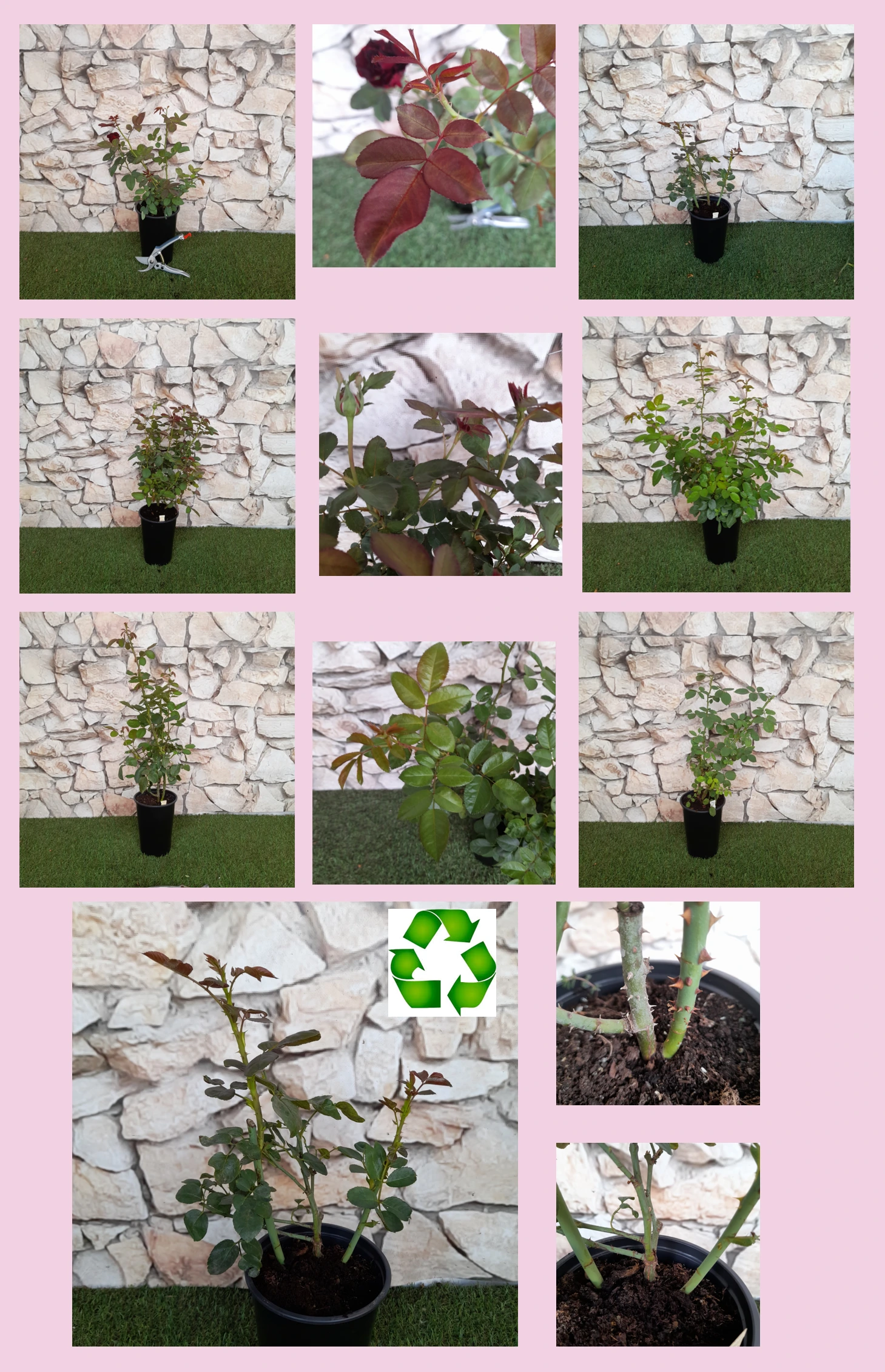
Crop overview: several varieties and growth stages in a short crop section.Shoot system: intensive growth of fresh basal shoots on a young plant.Root system: demonstration of a vigorous root system permeating the growing medium, by removing the pot.Balance: mature plant with root system and shoots in harmony with each other.
Information about the videos
The video series is not a “seasonal showcase”; it illustrates the essence of pharmaROSA® own-root cultivation in a tangible way: how the plant is built up, what the root system is like and how the shoot system regenerates. The recordings were therefore made at different times and with plants at various stages of development, so mixed foliage levels and differing stages of growth may appear in the videos. They are not a ‘sample’ of the batch dispatched, but a visual explanation of how the technology works. The current condition of the rose available to order — typical for the given period and similar to what you can expect to receive in the parcel — is shown in the upper part of the product page.
Pages for private customers Garden roses for the family garden, with minimal care → ORIGINAL® Premium garden roses – instant impact, a truly showpiece garden → EXTRA® Pages for professionals and private customers Roses for public spaces – large areas, sustainable maintenance → NATURAL® Roses for projects – hedge and row planting, fast implementation → RAPID® For professional partners only Production – propagation material for garden roses, wholesale → NEONATAL®
Company details
PharmaRosa Ltd. Company registration number: 01-09-717479 VAT number: 13075314-2-43 Plant health registration no.: HU130721 Bank account (IBAN): HU85117631891388688400000000 BIC (SWIFT): OTPVHUHB Bank name: OTP Bank Nyrt.